How the emission mechanism works
Qubic's monetary policy is not a single knob. It's a chain of protocol steps that runs at every epoch boundary. This page walks through the mechanism end-to-end, from gross emission down to the smart contract that actually removes QU from circulating supply.
If you've heard someone say "the halving" and wanted to know exactly what changes and where, this is the doc.
Two different things called "halving"
The word is used ambiguously across chains, and Qubic's version isn't the same as Bitcoin's:
- Bitcoin. The block-subsidy issuance itself is cut in half. Fewer new coins per block, permanently.
- Qubic. The gross emission is unchanged. What changes is the fraction of computor revenue that gets routed to a burn destination instead of being paid out to the computor.
Both produce a similar directional effect on net circulating supply. The mechanism is different.
Gross vs net emission
Every epoch (one calendar week), the protocol mints a fixed amount:
ISSUANCE_RATE = 1_000_000_000_000QU — one trillion QU per epoch. Defined at compile time inqubic/core/src/network_messages/common_def.hand unchanged since genesis.
This is the gross emission. What actually enters circulating user hands is smaller, because a portion of the gross emission is burned before it reaches computors. The difference is net emission.
The chain has several burn paths (SC-IPO Dutch auction bids, dust-threshold burns, XMR-driven programs, and more) — the one we're documenting here is the largest and the one the "halving" adjusts.
From gross emission to computor revenue
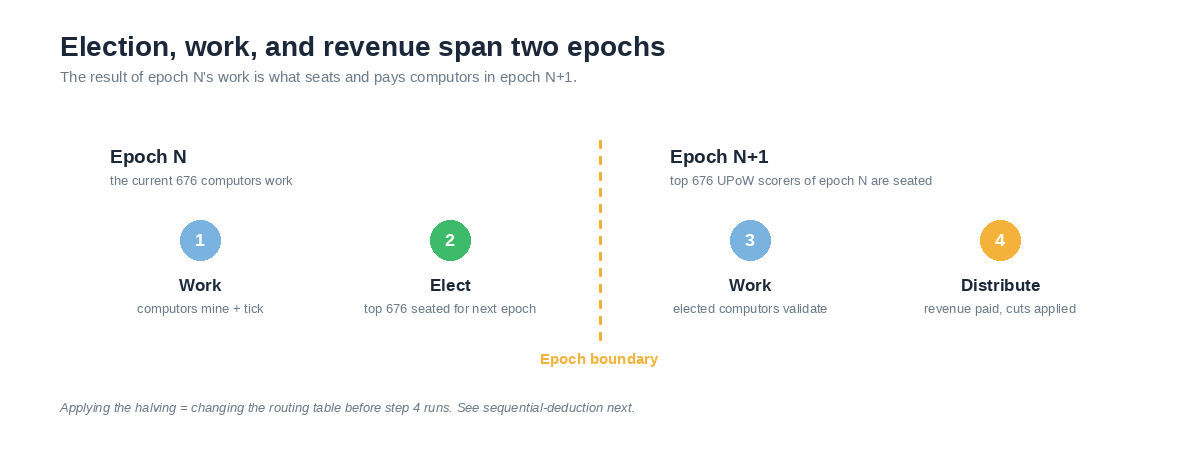
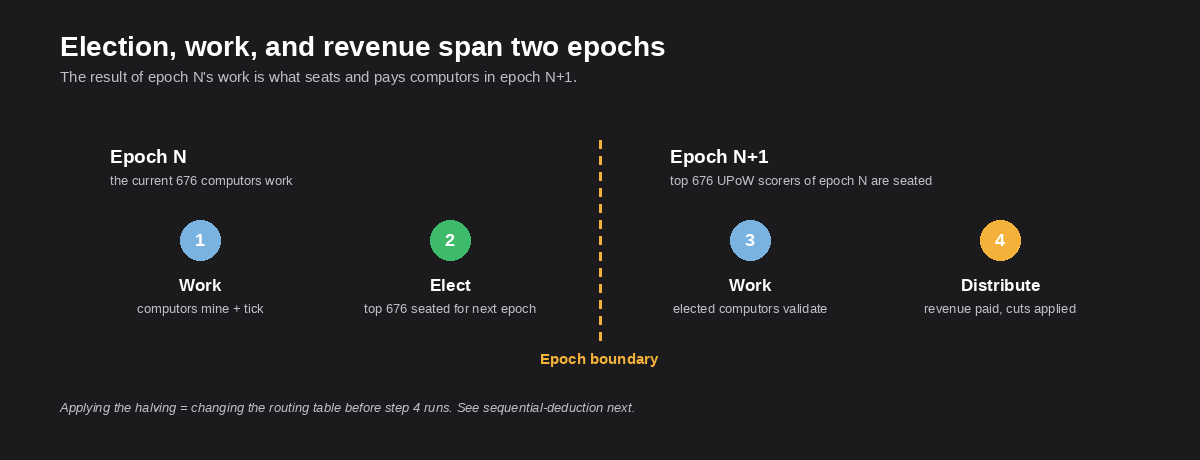
Emission does not go straight into circulating supply. It's paid out per epoch, based on per-computor performance, through this sequence:
- Epoch N: work. The 676 computors seated for epoch N produce ticks, sign votes, and process transactions. Their per-tick contribution is tracked.
- End of epoch N: revenue calculation. The core computes each computor's revenue for the epoch based on their performance.
- End of epoch N: donation-table pass. Before revenue reaches each computor, the routing table in the
GQMPROPcontract is applied sequentially (see next section). Each entry deducts a fraction of what remains. - End of epoch N: distribute. Whatever is left after the donation-table pass is paid to the computor; the residual of the epoch's ISSUANCE_RATE that wasn't consumed by computors goes to the arbitrator identity.
- Epoch N+1 begins. The next epoch's computor set is seated (elected from the highest UPoW-scoring identities of epoch N), and the loop repeats.
Points 2 and 3 happen inside endEpoch() in qubic/core/src/qubic.cpp. Point 5 is the boundary transition — see Upgrading for the tick-continuity mechanics.
The routing table
The revenue-donation table lives in the GQMPROP contract's on-chain state. Each entry is:
{
  destinationPublicKey  // where the routed portion goes
  millionthAmount       // fraction (in millionths — 1_000_000 = 100%)
  firstEpoch            // the first epoch this entry becomes active
}
The table has at most 128 entries. Entries can be added, modified, or replaced only by quorum vote — a computor submits a TransferInEpoch proposal via GQMPROP.SetProposal(...), computors vote via GQMPROP.Vote(...), and at the start of the next epoch GQMPROP.BEGIN_EPOCH() checks whether the proposal reached quorum (≥451 of 676) and majority for a non-status-quo option. If so, the entry is written into the table with the requested millionthAmount and firstEpoch.
Sequential application
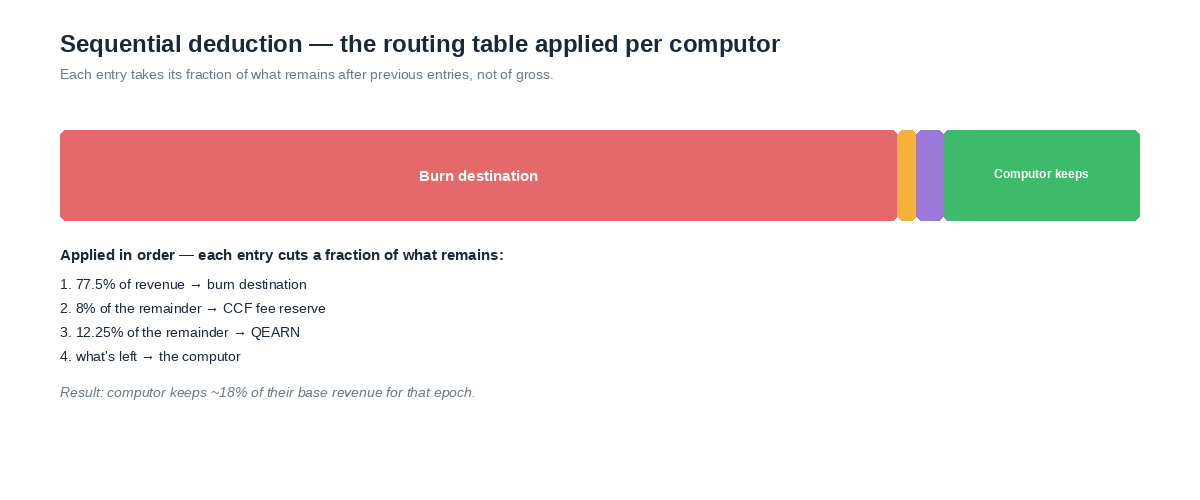
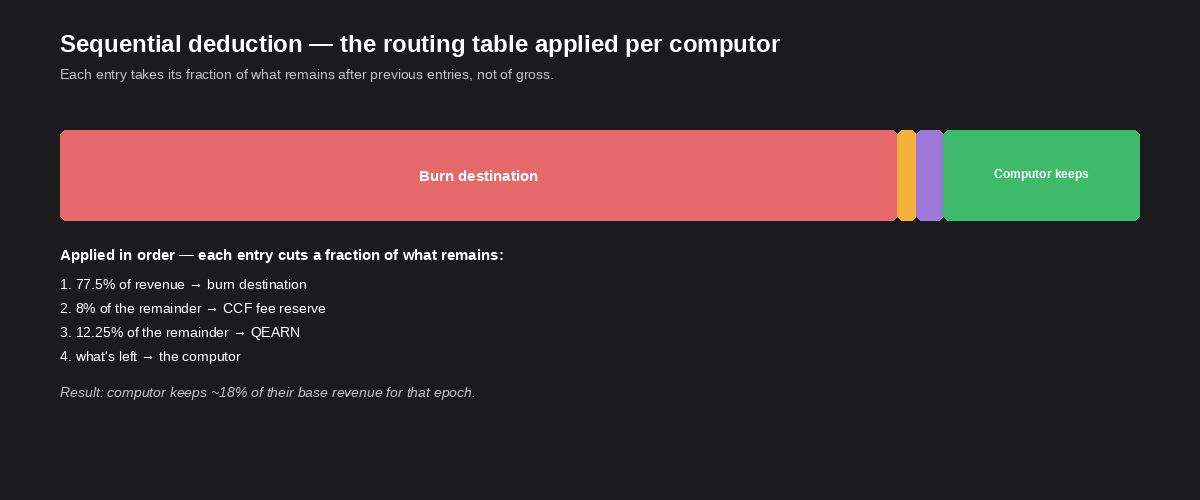
At endEpoch(), the routing table is applied sequentially, per computor. Each entry takes its millionthAmount / 1_000_000 fraction of what remains after previous deductions, not of the initial revenue:
revenue = base * performance
for each entry in table:
    if system.epoch >= entry.firstEpoch:
        donation = revenue * entry.millionthAmount / 1_000_000
        revenue -= donation
        // donation is sent to entry.destinationPublicKey
This means fractions don't add — they compound. If the table has one entry at 55% and another at 8%, the second doesn't take 8% of gross, it takes 8% of the 45% that remains.
Auto-cleanup at BEGIN_EPOCH
When an entry with a future firstEpoch becomes active, any older entry with the same destinationPublicKey is automatically removed by _CleanupRevenueDonation in GQMPROP.BEGIN_EPOCH(). No manual removal step is needed.
"Halving," restated
A "halving" in Qubic is just a quorum-approved entry — same destinationPublicKey as the previous burn-destination entry, higher millionthAmount, some future firstEpoch. When that epoch begins, the higher rate takes effect and the old entry auto-cleans.
You can inspect the current table live — see Inspect network state for CLI, GUI, RPC, and SDK examples.
SWATCH — the Emission SC
The routing table sends fractions of computor revenue somewhere. For the burn-share entry, that somewhere is the smart contract SWATCH (contract index 7) — the Supply Watcher / Emission SC.
SWATCH was created by an approved 2024 proposal as an infrastructure contract:
"To be able to burn Qubic according to the proposed emission schedule we propose to create the Emission Smart Contract. This SC will be responsible to burn the Qubic according to Emission schedule, the Supply Watcher. Computors or any other individual can donate/send Qubic to this SC. The SC will burn them. This is an infrastructure SC and will NOT generate any dividend for shareholders."
The proposal outlined two phases:
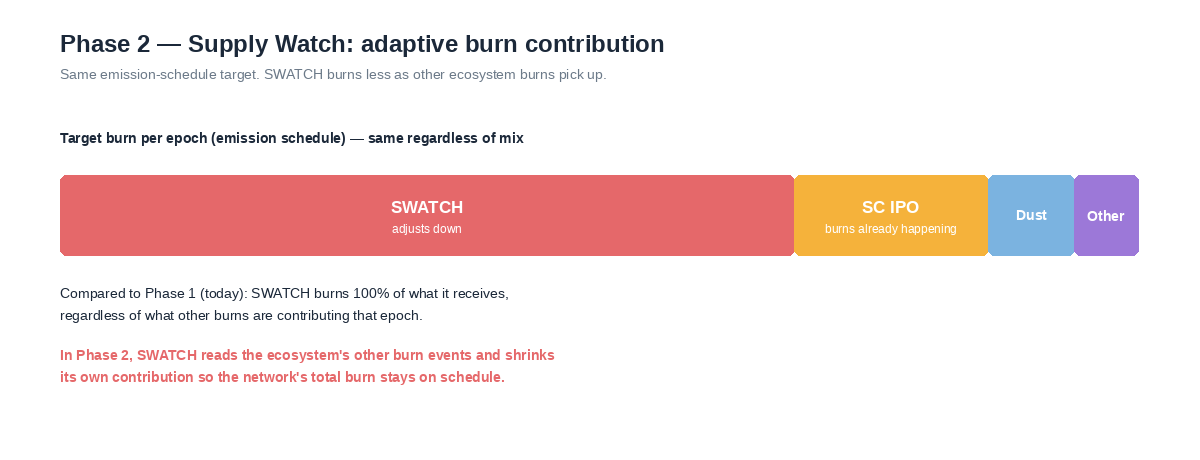
- Phase 1 — SC burns everything sent to it.
- Phase 2 — SC burns everything sent to it while taking existing ecosystem burns into account. This is where the "Supply Watcher" name earns itself.
What SWATCH does today
The current SWATCH implementation lives in qubic/core/src/contracts/SupplyWatcher.h — approximately 65 lines. It has one hook: BEGIN_EPOCH, no user functions, no state variables of its own.
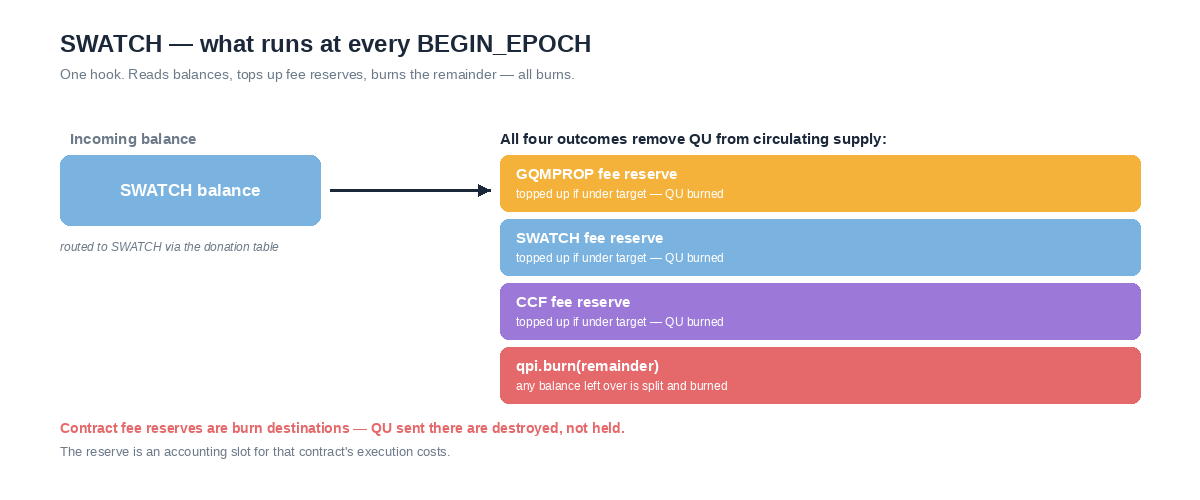
At each epoch boundary, SWATCH:
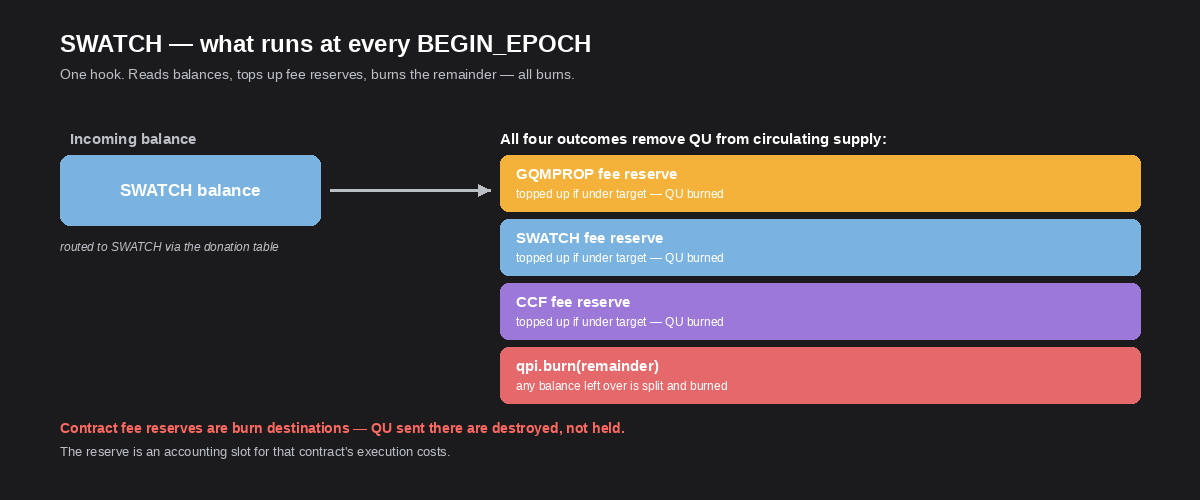
- Reads its own balance — QU routed to it during the previous epoch via the donation-table pass.
- Reads the fee reserves of three contracts:
GQMPROP(index 6),SWATCHitself (index 7), andCCF(index 8), viaqpi.queryFeeReserve(). - Computes a target — the average of those reserves + its own balance, split across three buckets, excluding buckets that are already above target.
- Distributes — calls
qpi.burn(amount, contractIndex)to top up any under-target reserves. - Burns the remainder — any balance still remaining after the top-ups is split evenly and burned via the same
qpi.burn()primitive.
Contract fee reserves are burn destinations
The crucial mental-model correction: QU sent to a contract fee reserve are burned, not held. contractFeeReserves[] is not a spendable balance the contract can transfer elsewhere. It is an accounting slot for the contract's own execution costs — decremented as the contract runs code (execution fees), never sent to a user identity.
Fee-reserve top-ups and the remainder's qpi.burn() call have the same effect on circulating supply — both remove QU from user hands permanently.
The reason SWATCH does both is efficiency: the same balance-inspection pass that decides how much to route to reserves also decides what's left over for the remainder burn. One BEGIN_EPOCH hook does both jobs.
Phase 2 — Supply Watch
The Phase 2 behavior from the same 2024 proposal is where the name literally applies:
"SC will burn everything sent to it while taking existing ecosystem burns into account. Supply Watcher."
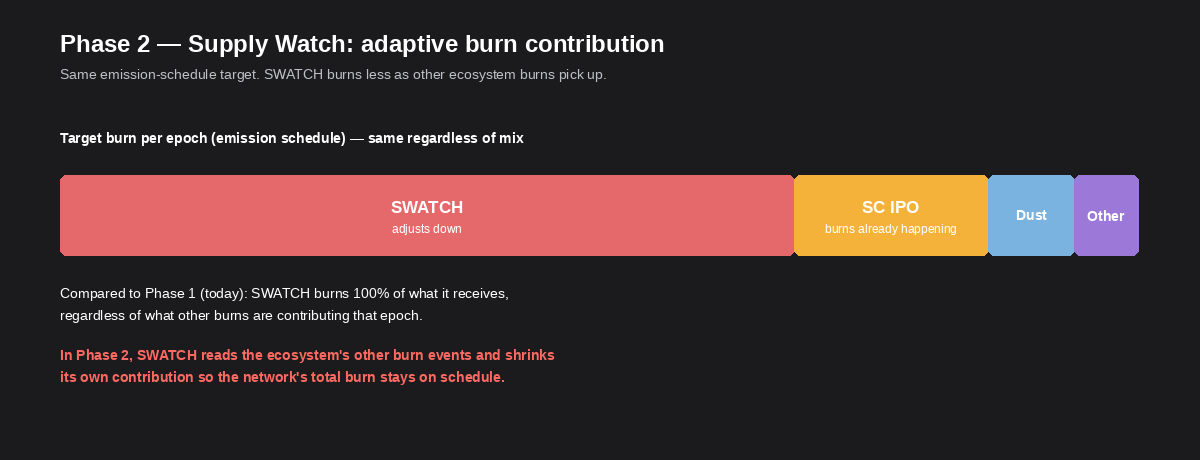
The intent is adaptive burn control. Ecosystem-level burns already happen outside SWATCH — SC-IPO Dutch auction bids are burned during finishIPOs() each epoch; the dust-threshold rules in qubic/core/src/spectrum/spectrum.h burn small balances when the spectrum fills past 75%; time-limited programs (like the 2025 XMR-driven program that burned ~672B QU) contribute periodically. In Phase 2, SWATCH would read those contributions and shrink its own burn accordingly so the network's total burn per epoch stays on the emission schedule.
Same emission-schedule target. Adaptive per-epoch contribution.
How to verify the current state
Every part of this mechanism is inspectable live. See the worked example in Inspect network state for step-by-step how to query the current revenue-donation table via:
qubic-cli -gqmpropgetrevdonation- Qubic.Net Toolkit → Governance → Revenue tab
- HTTP RPC
POST /v1/querySmartContract - The TypeScript SDK helper
generalQuorumProposalGetRevenueDonation() - The .NET SDK
QuerySmartContractAsync<GetRevenueDonationInput, GetRevenueDonationOutput>()
The same principle applies to inspecting SWATCH's balance, individual fee reserves, or any other on-chain state — the network exposes all of it; the tools just present it differently.
Sources
qubic/core— the codebase:src/network_messages/common_def.h—ISSUANCE_RATEsrc/qubic.cpp—endEpoch(), per-computor revenue loop, donation-table applicationsrc/contracts/GeneralQuorumProposal.h—revenueDonationtable + vote flow +_CleanupRevenueDonationsrc/contracts/SupplyWatcher.h— the SWATCH SC itselfsrc/qpi/impl/qpi_spectrum_impl.h—qpi.burn()implementation
- Whitepaper §14 · Governance — GQMPROP overview
- The approved proposal (2024): The new emission model — 80% supply cut — the origin of SWATCH and Phase 1 / Phase 2 design intent
Related documentation
- Inspect network state — CLI / GUI / RPC / SDK examples for querying the routing table and other on-chain state
- Tokenomics — overview of Qubic's monetary policy
- Governance — how quorum proposals work at the protocol level
- Upgrading — how the network transitions between epochs